Author: Fitzgerald Subaru of Gaithersburg Team
Maryland’s distinct four-season weather and busy commuter routes—like the daily stop-and-go on Interstate 270—put specific demands on your vehicle. At Fitzgerald Subaru of Gaithersburg, we understand exactly what it takes to keep your Subaru performing at its best, because we share these same roads. Over the years, our team has partnered with drivers from Germantown, Montgomery Village, Clarksburg, and Frederick to provide routine care that goes beyond the standard checklist, focusing on the real-world conditions we navigate every day.
This guide breaks down the factory-recommended maintenance schedule, translating those guidelines into practical advice tailored for our local terrain. Whether you rely on a spacious Outback for weekend outings to Seneca Creek State Park or a nimble Crosstrek for your typical 30-minute commute down Maryland Route 355, staying ahead of service milestones ensures your vehicle continues to deliver the safety, reliability, and capability you depend on.
Why Should You Follow a Maintenance Schedule for Your Subaru?
Sticking to a routine maintenance schedule is the most effective way to protect your investment and keep your Subaru running smoothly for years to come. What this means for Gaithersburg drivers is that your vehicle stays fully prepared for our region's specific environmental demands. Our distinct four seasons bring heavy spring pollen that can quickly clog cabin and engine air filters, while sticky summer humidity adds extra stress to your serpentine belts and cooling system. Whether you are navigating daily stop-and-go traffic on Maryland Route 355 (Frederick Avenue) or taking a loaded-up SUV to Seneca Creek State Park for the weekend, these local conditions steadily wear on your vehicle's components. Because the Subaru Boxer engine relies on precise lubrication and cooling to perform its best, following standard service intervals—like replacing the full synthetic oil and oil filter every 6,000 miles—prevents unnecessary friction and heat buildup that can lead to costly repairs.
Beyond simply avoiding unexpected breakdowns, proactive care directly impacts your daily driving experience, overall fuel efficiency, and safety. A well-maintained Outback or Forester handles better and runs much more efficiently when you are tackling your typical 29-minute morning commute down Interstate 270. For example, replacing a dirty engine air filter every 15,000 to 30,000 miles allows the engine to breathe properly, helping you maintain optimal gas mileage rather than forcing the vehicle to work harder and burn more fuel just to get up to speed. Staying ahead of fluid exchanges and routine inspections gives you total peace of mind, knowing your car is operating exactly as its engineers intended. If you are looking for even more insights on long-term vehicle care and ownership costs, trusted resources like Edmunds offer excellent guides to help you maximize the lifespan of your vehicle.
How Does Subaru’s Service Reminder System Work?
Many modern Subaru vehicles alert you when routine maintenance is due through a built-in dashboard reminder system. What this means for drivers in Gaithersburg is that instead of strictly guessing dates on a calendar, your car actively helps keep your maintenance on track. Depending on the exact equipment in your vehicle—like a 2026 Subaru Forester (Gas) or a 2027 Subaru Outback (Gas)—this reminder typically operates in one of two ways. Some setups use a straightforward time and mileage counter, often tracking a baseline 6-month or 6,000-mile interval. Others rely on a usage-aware calculation that estimates remaining oil life based on engine hours and operating conditions. Ever wonder why a service light might pop up a little sooner than expected? If you frequently commute in heavy traffic on Interstate 270 or manage stop-and-go driving along Maryland Route 355 (Frederick Avenue), those tougher routines naturally shorten the time between recommended visits compared to steady, open-road cruising.
When your vehicle determines it's time for a checkup, you'll usually spot a clear visual cue right behind the steering wheel. You might see a dedicated maintenance text message, an illuminated wrench icon, or a digital oil-life percentage screen. Because the exact alerts and tracking methods can differ from one trim to another, checking your owner’s manual is the best way to understand exactly what your specific dashboard is telling you. It's also worth noting that these calculations don't physically measure fluid quality or account for every environmental factor. Frequent short trips for errands around the Kentlands neighborhood, towing heavy loads, or dealing with Montgomery County’s unpredictable seasonal temperature swings can put extra strain on your engine fluids. Knowing how your reminder works ensures your Subaru stays reliable for the daily commute and weekend escapes to Seneca Creek State Park alike.
What Does the Primary Service Reminder Mean?
When a service indicator lights up on your dashboard, it simply means your Subaru is ready for its next round of scheduled care. Because the exact presentation varies by model year, newer vehicles like the 2027 Subaru Outback or 2026 Forester often use the center multi-function display to track specific time and mileage thresholds. What this means for Gaithersburg drivers is less guesswork—whether you are commuting daily on Interstate 270 or running errands around the Kentlands neighborhood, your vehicle handles the scheduling math for you. Think of this initial alert as a polite tap on the shoulder rather than an emergency alarm; it is just prompting you to check your owner’s manual or in-vehicle menus for the exact upcoming requirements.
Primary reminder: This acts as a high-level, universal heads-up that routine maintenance is due or fast approaching. Rather than pointing out one specific component, it tells you to review your factory schedule and plan your next dealership visit.
Additional details (if shown): Depending on your specific Subaru trim and year, your screen might provide extra context—such as a descriptive text menu, specific maintenance icons, or a mileage countdown in the vehicle settings. You can use these on-screen prompts alongside your owner's manual to confirm precisely what kind of attention your vehicle needs right now.
What Do Additional Service Indicators Mean?
Beyond the primary maintenance light, some Subaru vehicles provide extra details through dashboard symbols or specific menu alerts. What do these additional service indicators actually mean? In short, they act as specific prompts that pinpoint exactly which components need attention—taking the guesswork out of your maintenance routine. While the exact format and wording vary depending on the model you drive, these alerts are designed to keep your car reliable for everything from daily commutes to weekend adventures at Seneca Creek State Park. If you spot an extra message on your display, it is often pointing to one of these common service requirements.
- Tire rotation: Moving your tires to different positions evens out tread wear and maximizes their lifespan. If you commute via Maryland Route 355 (Frederick Avenue) or navigate stop-and-go traffic around the Kentlands, the constant braking and accelerating forces your front tires to work much harder. Rotating them—typically every 5,000 to 7,500 miles—ensures you maintain the confident grip Subaru is known for.
- Engine and cabin air filters: The engine air filter protects your motor from debris, while the cabin filter traps dust and allergens before they enter the interior. Heavy spring pollen in Montgomery Village or sitting in dusty regional traffic can clog these materials over time. Swapping them out keeps your HVAC system blowing strong and helps your engine breathe efficiently.
- Transmission fluid: Many Subaru models, like the Outback and Crosstrek, utilize a Continuously Variable Transmission (CVT) to optimize fuel efficiency. Frequent short trips around Gaithersburg or inching along in I-270 gridlock generates extra heat and stress inside the gearbox. Over time, your vehicle may prompt an inspection or exchange of this fluid to keep your acceleration perfectly smooth.
- Spark plugs and valve clearance check (when applicable): Spark plugs are responsible for igniting the fuel in your SUBARU BOXER engine. A service reminder for this job usually appears at a higher mileage interval—often around the 60,000-mile mark, depending on your vehicle. At this stage, a valve clearance inspection might also be recommended to ensure the engine continues running at peak performance.
- Engine coolant: Coolant regulates engine temperatures, preventing overheating during muggy Maryland summers and freezing in the winter. Demanding conditions, like towing a small trailer with your Subaru Ascent or tackling long highway trips, gradually break down the fluid’s protective additives. Fresh coolant safeguards your water pump and internal engine parts from corrosion.
- Rear differential fluid (AWD/4WD, if equipped): Because Symmetrical All-Wheel Drive is central to the capability of models like the Forester Wilderness, the rear differential works continuously to distribute power to the back wheels. Navigating wet, slick roads in Clarksburg or battling winter snow puts heavy demands on these gears. Refreshing the differential fluid removes metal shavings and maintains that legendary all-weather traction.
- Brake fluid: Brake fluid naturally absorbs moisture from the air as it ages, which slowly lowers its boiling point and can make your brake pedal feel soft or spongy. When this service indicator pops up, it means it is time for a flush. Clean fluid guarantees your brakes will respond firmly and safely when traffic suddenly halts on Great Seneca Highway.
What is a Typical Subaru Service Schedule for Gaithersburg Drivers?

Knowing when to schedule routine care for your Subaru Forester or Outback is essential for long-term reliability. What this means for Gaithersburg drivers is that following a predictable maintenance roadmap keeps your vehicle running safely, whether you are tackling winter slush or summer heat. While your owner’s manual and any equipped in-dash alerts should always serve as your absolute source of truth, reviewing a typical service timeline makes it much easier to budget and plan ahead. For example, if you know that a standard Subaru maintenance milestone typically occurs every 6 months or 6,000 miles, you can seamlessly coordinate upcoming shop visits before an alert ever appears. If your daily routine involves heavy stop-and-go commuting on Interstate 270 or running quick, repetitive errands around the RIO Washingtonian Center, those frequent short trips often place more stress on vital components than steady highway cruising. The general outline below acts as a helpful planning aid to complement your official factory guidance, tailored to the everyday driving patterns we see across Montgomery County.
What Services Are Needed in the First 30,000 Miles?
During your first 30,000 miles, maintenance is mostly about foundational care to keep your vehicle running at its best. What this means for Gaithersburg drivers is that staying on top of these early basics protects your Boxer engine and maintains your Subaru's renowned Symmetrical All-Wheel Drive system. While exact timing depends on your owner's manual, many modern vehicles—like the 2026 Subaru Forester or Impreza—typically call for synthetic oil changes around the 6,000-mile mark. However, if your daily 29-minute commute involves heavy stop-and-go traffic on Route 355 (Frederick Avenue) or frequent short trips around the Kentlands, you might need to schedule these services closer to a 5,000-mile interval. Pushing an oil change to 10,000 miles under those heavy suburban driving conditions can increase engine wear over time.
Tire rotations: Ever wonder why tire rotations are stressed so early in ownership? Because your Subaru relies on continuous Symmetrical All-Wheel Drive, maintaining nearly identical tire tread depth across all four wheels is critical for system performance. We typically suggest rotating your tires at every oil change, or roughly every 6,000 miles. Keeping tread wear uniform ensures you maintain optimal traction when navigating wet weather on I-270 or taking an unpaved trail down to Seneca Creek State Park in a 2026 Subaru Outback Wilderness. Consistent rotations early on also extend the overall lifespan of your factory tires, which saves you money.
Engine and cabin air filters: Your engine’s air filter and the interior cabin filter are usually inspected at every service visit, with replacement commonly falling somewhere in the 15,000- to 30,000-mile window. Local environmental factors dictate this timeline heavily. For example, dense spring pollen across Montgomery Village or blowing dirt near construction zones in Clarksburg can clog these materials much faster than standard highway driving. Swapping out a dirty cabin filter ensures you breathe fresh air during your drive, while a clean engine filter helps a 2026 Subaru Crosstrek breathe properly, maximizing fuel efficiency for weekend trips out to Frederick.
What Maintenance Should Be Done Between 30,000 and 60,000 Miles?
Between 30,000 and 60,000 miles, your Subaru transitions from basic break-in upkeep to essential system preservation, focusing heavily on critical fluid exchanges and thorough wear inspections. What this means for Gaithersburg drivers is that components enduring daily regional commutes need proactive care to maintain their legendary dependability. Because the exact timeline varies depending on whether you pilot a turbocharged WRX Sedan or a family-hauling Ascent SUV, you should always consult your owner’s manual or in-vehicle displays for the precise schedule that fits your powertrain and lifestyle. In fact, when reviewing trusted industry resources like Consumer Reports, you will find that staying on top of these mid-life service milestones is a leading factor in maximizing a vehicle's long-term owner satisfaction.
Transmission fluid service: A primary focus during this mileage window is transmission care. For many Subaru models equipped with a Lineartronic® CVT (Continuously Variable Transmission)—such as the Outback Gas SUV or Crosstrek Gas SUV—fluid inspections or complete exchanges are often recommended as you cross into the 30,000 to 60,000-mile territory. This is particularly important if your vehicle experiences what manufacturers consider "severe" driving conditions. Consider the daily stop-and-go congestion on Interstate 270 or the extra strain of hauling weekend gear out to Seneca Creek State Park; these scenarios generate excess heat that degrades transmission fluid more quickly. Because a CVT relies on precise friction, exchanging depleted fluid ensures that the system's complex internal mechanisms stay properly lubricated, preserving smooth power delivery and preventing costly wear.
Brake fluid, pads, and tires: Alongside drivetrain health, your stopping power requires close attention. Brake fluid naturally absorbs moisture from the environment over time, which can lower its boiling point and lead to a spongy brake pedal. Because of this chemical reality, flushing and replacing brake fluid is frequently treated as a time-based necessity—often recommended roughly every 30 months or 30,000 miles, regardless of your actual mileage. During this same window, diligent brake pad and tire tread inspections become increasingly critical. When unpredictable seasonal rain hits while you are navigating the steady traffic of Quince Orchard Road (MD 124) or Montgomery Village Avenue, having adequate tire tread depth (ideally above 4/32 of an inch) combined with fresh brake fluid provides the confident, predictable handling necessary to keep your loved ones safe.
What Major Services are Required Approaching 100,000 Miles?
As you approach 100,000 miles, the major services commonly required include replacing spark plugs, servicing the engine coolant, and—depending on your vehicle's age—addressing the timing belt. Hitting the six-figure mileage mark is a proud moment, whether you have racked up those miles commuting down Interstate 270 or taking weekend family drives to Seneca Creek State Park. While not every Subaru needs the exact same work at this specific stage (always check your owner’s manual for your model's schedule), keeping up with these larger milestone items ensures your vehicle stays dependable for the long haul. Here is a closer look at what to expect as your odometer climbs.
Spark plug replacement: Because modern Subaru Boxer engines fire their spark plugs millions of times over the years, the metal electrodes eventually wear down. Subaru typically recommends replacing spark plugs every 60,000 miles, which means your next major interval is approaching right after you cross that 100k threshold. Fresh plugs restore crisp acceleration and help maintain fuel efficiency during stop-and-go traffic on Maryland Route 355 (Frederick Avenue).
Timing belt or chain inspection: If you drive an older Subaru, it might rely on a rubber timing belt that generally needs replacement near the 100,000-mile mark to prevent sudden engine failure. On the flip side, most modern Subaru vehicles feature a high-strength metal timing chain. These chains do not have a routine replacement schedule and are designed to last the lifetime of the engine under normal driving conditions.
Engine coolant service: Over time, the anti-corrosion additives in your radiator fluid simply lose their effectiveness. Even though factory-fill Subaru Super Coolant is incredibly robust—often rated to last up to 11 years or 137,500 miles—a complete coolant flush is eventually required to protect the internal cooling passages from rust and overheating. Protecting the engine with fresh fluids is one of the easiest ways to safeguard your investment. In fact, you can always reference Kelley Blue Book to see exactly how staying on top of scheduled care preserves long-term vehicle value.
Why is Local Expertise Important for Servicing Your Subaru?
A service team that knows the Gaithersburg area understands that your daily drive is uniquely demanding, which directly impacts how your vehicle should be maintained. If you commute daily via Maryland Route 355 (Frederick Avenue) or tackle the notorious stop-and-go congestion on Interstate 270, the constant braking and idling accelerate wear far more than standard open-highway cruising. Local technicians see firsthand how Maryland’s sweltering, humid summers tax your A/C compressor and engine coolant, while our dense spring pollen seasons can rapidly clog your genuine Subaru cabin air filters. Because Subaru models like the Forester and Outback rely heavily on clean air intake and precise temperature management to perform efficiently, regional experts typically recommend inspecting and replacing these cabin filters every 12,000 to 15,000 miles when seasonal allergens peak. Furthermore, navigating winter ice or heavy summer rainstorms requires a perfectly balanced Symmetrical All-Wheel Drive system, meaning a local tech will closely monitor tire tread depth and inspect continuously variable transmission (CVT) fluid for signs of severe-use thermal breakdown. What this means for Gaithersburg drivers is that your maintenance schedule isn't just a generic checklist—it’s actively tailored to your environment, preventing regional road stresses from turning into costly repairs.
Whether you are packing up the family for a weekend at Seneca Creek State Park or just running errands through the Kentlands neighborhood, having a localized set of eyes on your suspension and brakes offers profound peace of mind. Beyond regional knowledge, it is always a smart idea to stay updated on broader automotive standards. Drivers can explore the National Highway Traffic Safety Administration (NHTSA) for official safety ratings, crash-test data, and recall information. Combining these trusted national resources with service experts who intimately understand Montgomery County’s driving conditions ensures your Subaru is always prepared for the road ahead.
Frequently Asked Questions (FAQs)
How does Fitzgerald Subaru of Gaithersburg manage service wait times and keep customers informed?
Fitzgerald Subaru of Gaithersburg's team utilizes our ISO 9001 quality management processes to ensure your factory-certified service is completed as efficiently as possible. Our 100% employee-owned staff delivers transparent "FitzWay" communication, so you always know exactly when your vehicle will be ready for your drive down I-270.
How can I ensure my appointment is scheduled efficiently?
Fitzgerald Subaru of Gaithersburg's team provides our signature "FitzWay" customer-first service to guide you through a seamless scheduling process. By relying on our six-decade legacy of automotive expertise, we plan your factory-certified service effectively so you can quickly get back to running errands around the Kentlands neighborhood.
How does Fitzgerald Subaru of Gaithersburg keep me informed during my factory-certified service?
Fitzgerald Subaru of Gaithersburg's team delivers our signature "FitzWay" transparent communication throughout your entire service visit. Our employee-owned staff will update you immediately on any necessary adjustments, ensuring a customer-first experience that aligns with our ISO 9001 quality management standards.
How does Fitzgerald Subaru of Gaithersburg accommodate my schedule for service appointments?
Fitzgerald Subaru of Gaithersburg's team delivers customer-first service designed to flexibly support drivers across Gaithersburg, Germantown, and Montgomery County. Our 100% employee-owned staff leverages our proven automotive expertise to manage the flow of factory-certified service smoothly, no matter when you drop off your vehicle off Route 355.
How does Fitzgerald Subaru of Gaithersburg support the local community?
Fitzgerald Subaru of Gaithersburg's 100% employee-owned team is deeply rooted in local involvement, regularly championing pet adoptions through the Subaru Loves Pets initiative. We also host certified child safety seat inspection stations and drive green power efforts in alignment with our ISO 14001 environmental certification, giving back to the greater Washington, D.C. area.
What awards and certifications highlight the quality at Fitzgerald Subaru of Gaithersburg?
Fitzgerald Subaru of Gaithersburg is proud to be part of the first automotive dealership group in North America to earn both ISO 9001 quality management and ISO 14001 environmental certifications. Our commitment to transparent, "FitzWay" service has also been recognized with the prestigious National Capital Business Ethics Award, reflecting our six-decade legacy of trust.
About Fitzgerald Subaru of Gaithersburg
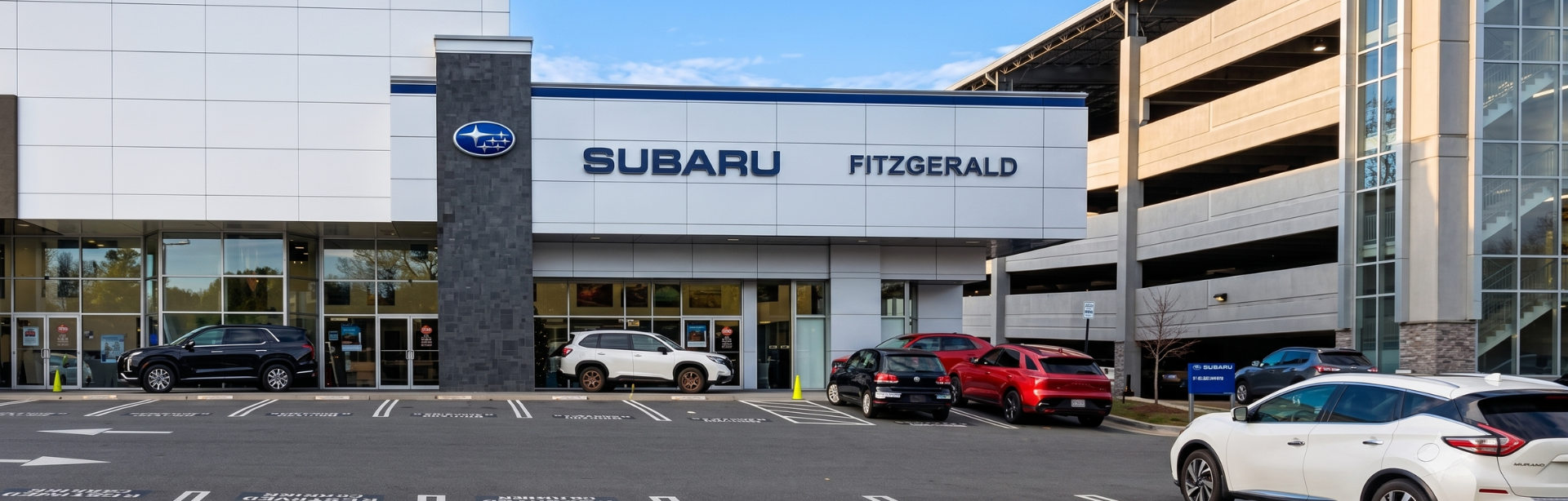
At Fitzgerald Subaru Gaithersburg, we are proud to serve drivers across Gaithersburg, Germantown, Montgomery County, and the greater Washington, D.C. metropolitan area with unrivaled automotive expertise. Since Jack Fitzgerald established our founding principles in 1966, we have built a six-decade legacy of trust by delivering our signature "FitzWay" transparent, customer-first service. As part of the first automotive dealership group in North America to earn ISO 9001 quality management and ISO 14001 environmental certifications—alongside receiving the prestigious National Capital Business Ethics Award—we set the gold standard for industry excellence. Our 100% employee-owned team is deeply rooted in local community involvement, regularly championing pet adoptions through the Subaru Loves Pets initiative, hosting certified child safety seat inspection stations, and driving green power efforts. Whether you need expert vehicle purchasing guidance or factory-certified service, you can rely on our proven experience and passion for putting our customers and community first.